Fire Extinguishing Systems Equipment

Butterfly Valves for Fire Extinguishing Systems: Design, Operation, and Application Features
Butterfly valves manufactured by PromArm are widely used in fire protection systems thanks to their reliability, compact design, and high flow capacity. They provide effective control of extinguishing media (water, foam, gas) and are used in both sprinkler and deluge systems.
The PA 300 DN 50-300 series valves have been certified in accordance with the mandatory requirements of TR EAEU 043/2017. Their reliability is confirmed by independent test reports.
The design of the fire protection valves has been improved and reinforced, meeting all tightness requirements specified in Regulation 043/2017 (leakage testing in closed position at 1.5PN pressure).
1. Design and Operation Principle
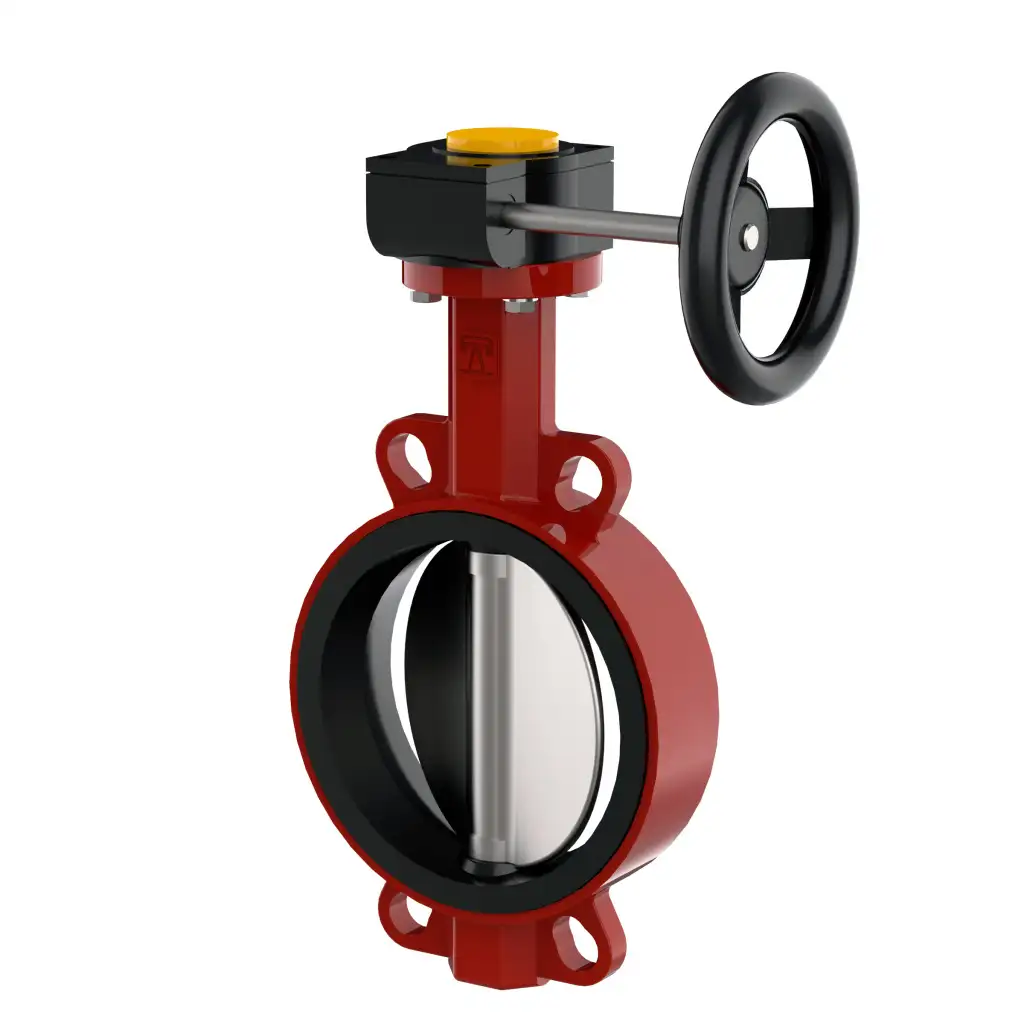
1.1 Key Elements
A butterfly valve consists of the following main elements:
- Body – made of cast iron, steel, or stainless steel, ensuring tightness and structural strength.
- Disc – made of cast iron, stainless steel CF8, CF8M, bronze, or other media-resistant materials. The disc rotates around its axis to open or close the flow.
- Seal – made of rubber (EPDM, NBR, VITON), PTFE, or other polymers, ensuring tightness in the closed position.
- Actuator – can be manual (lever, gearbox), electric, or pneumatic. All manual and pneumatic valves are equipped with position indicators—either separate limit switches or a block of limit switches (BLS)—according to customer requirements.
1.2 Operation Principle
Rotating the disc 90° fully opens or closes the flow. Unlike wedge gate valves, butterfly valves require a shorter travel, enabling faster operation.
2. Advantages of Butterfly Valves in Fire Extinguishing Systems
- Compactness and low weight – easy to install in confined spaces, minimal load on pipelines.
- High actuation speed – critical in emergency situations.
- Low hydraulic losses – ensures efficient supply of extinguishing media.
- Durability and easy maintenance – minimal moving parts reduce failure risk.
- Versatility – suitable for water, foam, and gas systems (e.g., CO₂).
3. Selection Criteria for Butterfly Valves
When choosing a valve for a fire extinguishing system, consider:
- Material of body, disc, and seal.
- Working pressure and temperature.
- Type of actuator – lever, gearbox, pneumatic, or electric.
- Availability of required certification and documentation.
| Applied Series | Technical Characteristics | Working media temperature | DN (mm) | MPa |
|---|---|---|---|---|
|
PA 300
|
features a symmetrical disk and an elastomer sealing element |
+180°С |
50-300, except DN 125 |
1,6 |
4. Applications
Butterfly valves are used in:
- Sprinkler systems – for zonal section isolation.
- Deluge systems – in water or foam supply pipelines.
- Gas fire suppression – controlling halon or CO₂ flow.
- Block and stationary automatic fire suppression systems (UAPT).
- Pumping stations – as shut-off and control valves.
Conclusion
Butterfly valves are a crucial component of modern fire extinguishing systems, providing reliable and fast control of extinguishing media. Proper selection and installation improve fire safety efficiency and reduce the risk of emergency situations.
When designing systems, it is recommended to consider valve technical specifications, operating conditions, and regulatory requirements.